In this session we focus on the contemporary connections between science, technology, and politics. The connections between these three domains are often neglected or unjust presented as complete seperated area’s. Bruno Latour speaks of matters that matter, by which a public around an issue (that matters) is created. Without a concern, there is nobody interested in a debate logically spoken.…
The Populist Imagination comes in a timely moment. The 20th issue of Open, the cahier on art and the public domain published by NAi, is a collection of essays dealing with “the role of myth, narratives and identity in politics”. Contributions include authors as diverse as Argentinian political theorist Ernesto Laclau, Italian writer collective Wu Ming, American media scholar Stephen Duncombe, and French literature professor Yves Citton, among others.
The subject of populism – and, more generally, myth-making – is especially urgent these days, mostly because of two world-scale phenomena: the emergence of political figures and movements that are strongly characterized by a mythological appeal, and the mass-mediated channeling of collective imagination sustaining such figures.
On both ends of the political spectrum, both President of the United States Barack Obama and Dutch right-wing politician Geert Wilders represent media-savvy interpreters of widespread heart-felt emotions, supported by a matching rhetorics of desire and imagination.
Be it the change promised by Obama or the evil forces of communism which Silvio Berlusconi claims to protect Italy from, from the United States to Europe we’re all experiencing a return to epic narration in politics.
Internet, social media, and a general decentralization of political discourse have made populism a widespread phenomenon, giving unprecedented space to previously marginal factions. Geert Wilders’ PVV party in the Netherlands, Lega Nord in Italy, and the Tea Party in the US, show how similar rhetorics have caught on throughout the Western world.
Open source, open government, open culture – as Nate Tkacz, PhD at the University of Melbourne points out in his talk at the Economies of the Commons Conference, the ubiquity of ‘openness’ as a master category of politics in network cultures turns into a multidimensional, and even more into a political term in the debate on the free and open. With referring to historical notions of openness, Tkacz makes some critical statements on the function of the open with particularly discussing it on the basis of Karl Popper’s work on ‘The Open Society and its Enemies”.
Ekaterina Yudin
|
18 October 2010, 12:17 am
|
tags: campaining, crowdsourcing, danah boyd, elections, information visualization, Memes, misinformation, new media, news, npr, politics, social media, social networking sites, truthy, twitter
“Swiftboaters beware!”
The battle to control Congress is on and this election year the truth is about to get Truthier. Twitter – the social media network, twenty-four-hour news site, conversation and blogging platform, wedding and death announcement site, gossip patrol, and the general online information center that…
Twitter is a combination of different elements and content that other Internet sites and platforms already had. To me, this is what makes Twitter so great: in a way my usage of the Internet is being channeled and collected by one single website or app (depending on whether I access it via the Web or via my phone). It’s a…
Create the change, become a Twitizen, fight injustice and eff the system. Revolution here and revolution there. Everywhere we hear about how social media and micro-blogging has brought about a tremendous change in the organization of social movements and political activism. We constantly get to hear about the so worn out issue of “Twitter Revolutions” all around the world and the news praising the immense effect that the influential social media movement is having on governance and political change. But where exactly is the revolution?
Where lies the power in network society? That’s the question Manuel Castells tries to answer in his book ‘Communication Power’. An interesting and relevant question considering our changing society. According to Castells, power relationships operate in networks. In his book he concentrates on the communication networks, because power relations are mainly based on shaping the human mind. So, according to…
I do believe the Web 2.0 is shaping our societies, and much more the way users relate to each other.
Social movements are adopting very fast social media technologies in their communication strategy. They use social network sites mostly for campaigns, dissemination of information, news and awareness raising among the public.
Raymond Williams in his essay The Technology and the…
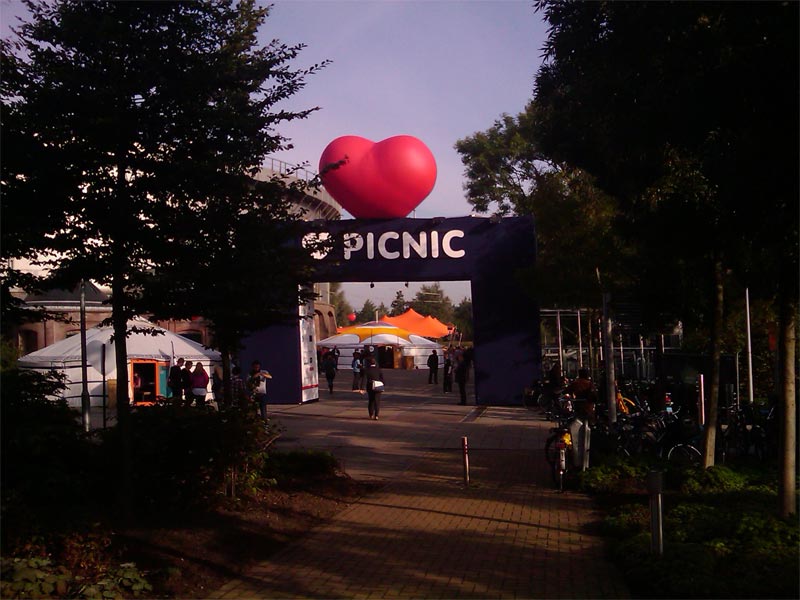
Today i’m present at Picnic’10 and i’m really excited to be here. I will be live blogging today via the ‘Masters of Media’ blog and also on my personal Twitter. Don’t hesitate to ask if there are any questions about PICNIC10.
Right now i’m in the seminar ‘The European Street Challenge‘, it’s about making a difference, especially through creative thinking:
A European Digital Design – Myth or Reality? A collaboration between the Futur en Seine, PICNIC, French and Dutch Designers, and the Paris and Amsterdam municipalities. Can European creatives design digital solutions across European cultures? A Parisian company can create and design a distinctive and expressive product for Paris. Can it do the same for Amsterdam?
Last week I attended a conference on Internet, Policy and Politics at the OII in Oxford. I was invited to present my paper based on my MA research conducted in Brazil, which I finished a couple of weeks ago.