Author Profile

  • Michael Stevenson
  • Url: http://www.whateverbutton.com/blog
  • Posts: 70
  • About the user: I am a lecturer and PhD candidate in Media Studies at the University of Amsterdam. I've been a contributor to Masters of Media since 2006, though I now only post occasionally. A short list of papers and projects can be found here

Author Archive

Web culture circa 1995 – some first thoughts on the history of HotWired and Suck.com

“Early histories of ‘the digital content revolution’ will center around one area, San Francisco’s South Park.” (Justin Hall talking about San Francisco’s multimedia gulch)

I’m in the bay area researching HotWired – Wired’s ambitious website created in 1994 – feeling like I’ve stumbled on a fairly pivotal event in the transition from cyberpunk-and-VR-driven cyberculture to something recognizable as today’s web culture. Here are a couple of observations from the field:

Web Words: a Vocabulary of the Web Interface

The Web is ‘Search’ and ‘More.’ We already know this intuitively: online content, and our experience of it, is mediated by the range of views and actions made available by the interface and, increasingly, the engine. Web Words is an initial contribution by digital methods to the study of the words employed for what one sees and does on the Web, as well as their larger, online-cultural meanings.

Patrick Lichty’s manifesto, The 50-Year Computer

The Slow Computer Movement is born:

I have a proposition to make – when I am ready for my first mind/body
transplant in 2058, at age 95, I want to be using the same computer I am
today.

Intrade Being Scammed?

One of the more interesting developments in the ‘Many Minds’ area of Web 2.0 is the futures market, where people basically bet on an outcome of a particular event, such as an election or, recently, whether Hurricane Gustav would hit New Orleans. Sites like Intrade have been praised for their ability to draw from the wisdom of crowds to make surprisingly accurate predictions. The logic behind this is laid out very well by people like Clay Shirky, who’s speaking at Picnic tomorrow, and in Cass Sunstein’s book Infotopia.

Generation Geenstijl, or a Virtual Death Threat in Parliament

It’s already old news (that’s what I get for reading the Saturday paper on a Sunday) but I saw this article earlier: “Geenstijlgeneratie bedreigt erop los,” which I’ll embellish in translation as “Generation Geenstijl issues threats like there’s no tomorrow”. Geenstijl means ‘No Style’ and, of course, refers to one of the most popular blogs in the Netherlands.

*Updated* Hyves Pulls Plug on Student Projects After Waag Society Event

((Looks like a possible false alarm, please see update below))
Online social network Hyves has blocked access to the profiles pages for unregistered users. Now one has to be registered and logged in to view a Hyver’s full profile, which was not the case previously. The move by Hyves – the most popular social networking site in the Netherlands – comes a day after a series of student presentations

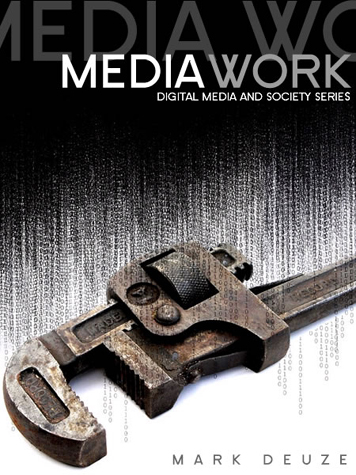
Mark Deuze on Media Work

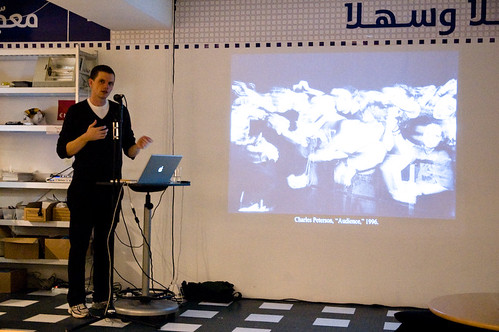
Mark Deuze, professor of Journalism and New Media at Leiden University and assistant professor at Indiana University, was the latest speaker in the ongoing New Media Research Lecture Series here at the University of Amsterdam, and spent the afternoon discussing his latest book, Media Work.

Uncontemporary Media Theory: a Course Outline Manifesto

Amsterdam, May 2008

By Michael Stevenson, Rosa Menkman, Jasper Moes, Erinc Salor and Esther Weltevrede (MA mediastudies, University of Amsterdam) with Geert Lovink

Bruce Sterling’s Dead Media Project, now expired, was on to something. In the rush to discover and define the new, there is never patience for what is being replaced. A pet project still sporadically referenced on Sterling’s blog, the idea was to document the ’spiritual ancestors’ of today’s media.

Notes on Paul Virilio’s War and Cinema

This is a summary of Virilio’s book, War and Cinema: The Logistics of Perception. I read this for a class on German Media Theory – alongside Elias Canetti’s Crowds and Power, Klaus Theweleit’s Male Fantasies and Friedrich Kittler’s Gramophone, Film, Typewriter.

URLs registered for the U.S. Elections

For those of us who thought domain name grabbing went out of style in the 1990s.. The Caucus blog at New York Times reports that the Republican National Committee has been parking domain names in preparation for the general election.