Glympse is a groundbreaking new way to share your location with anyone for a specified period of time using patent-pending GlymseWatch timer.
This app enables you to immediately share your location with friends and allows them to track your movement for a chosen amount of time.
It is supposed to be ‘Groundbreaking’ for several reasons:
First of…
Emina Sendijarevic
|
06 May 2011, 8:27 am
|
tags: 3D, 3D thinking, augmented space, cartography, datavisualisation, gaming industry, Geovisualization, human computer interaction, immersion, maps, virtual spaces, virtual worlds
In the last 30 years advances in computer science and computer graphics have largely contributed to making maps interactive and dynamic. Interactive, computerized maps have the advantage of enabling the user to interact with the display, but are also able to express additional information for the user’s interest (Andrienko & Andrienko, 1999). Still, the emphasis of interactive computerized maps, as…
The last couple of weeks, my data-visualization team and I, have been working on our Europeana project. Europeana is a big heritage-digitization project funded by the European Union. Their goal is to digitize all of Europe’s heritage objects and to make them available online. There are several reasons why the EU wanted to create such a huge and expensive…
Chris Hoogeveen
|
13 March 2011, 10:20 pm
|
tags: 7 Scenes, Alexander Galloway, augmented reality, augmented space, Australian, Ayer's Rock, Ben Russell, Bijlmer Euro, bloggers, Britglypgh, Carnivore, Christian Nold, Critical Media Art, data visualisation, data visualization, Deleuze, digital art, George Orwell, Gilles Deleuze, gizmodo, GPS, Headmap Manifesto, iphone, Jonthan Harris, Kazys Varnelis, Layar, Layers, Lev Manovich, locative media, mapping, maps, Marc Tuters, media art, Milk, Orwell, participants, real, Rizome.org, Sep Kamvar, Uluru, Urban Augmented Architecture, virtual, We Feel Fine, Webstalker, Wi-Fi
Layla van Daalen, Chris Hoogeveen, Hanneke Mertens
Every aspect of the world has an extra layer of information. It may not always be obvious, but these extra layers are most certainly present. Marc Tuters and Kazys Varnelis describe these extra layers as a form of augmented space. This is an extra layer of information, of data visualization on top of…
Radmila Radojevic
|
19 May 2010, 6:40 pm
|
tags: Alejandro de Lacosta, cartography, Crampton, Emotional cartography, GPS, Hemment, information visualization, Laila el-Haddan, Latino/a America, locative media, mapping issues, maps, Muchon Zer-Aviv, Nold, Parks, Running Stitch, Sotelo-Castro, You Are Not Here
“Perhaps one of the most important characteristics of . . . [a] map [is that it] has multiple entryways as opposed to the tracing, which always goes back “to the same.” The map has to do with performance”. (Deleuze and Guattari 1980/1987, 13-14)
According to Crampton “cartography should be understood as existence (becoming) rather than essence (fixed ontology)” (Crampton, 2009)…
Pedro M Cruz created recently a Project related with the visualization of Traffic in Lisbon. His project lets you see the city waking up through the motion of traffic on its main arteries and fading away towards the end of the day. It also shows you which are the streets with swifter traffic, green lines, and the ones with traffic…
When we think of Maps, we are prone to think of a visual, detailed and accurate representation of an area. Our most common idea of maps is that they serve the purpose of depicting geography, we may think particularly about cartography and topography.
Maps are one of the ways we have been using since the Bronze Age, to make…
When the french philosopher Alain Badiou presented his essay “Fifteen Thesis on Contemporary Art” published in 2004, he took an artwork by Mark Lombardi, as an illustration of his talk. This artwork was a map. It was more exactly a pencil diagram, entitled as “George W. Bush, Harken Energy and Jackson Stephens, ca 1979-90″,…
Katy Börner, with her presentation Global Brain Pressures: Towards Scholarly Marketplaces, asks what the relationship is between knowledge and the individual, and knowledge and networks. Over a long enough timeline, one sees increasing specialization, and thus a changing perception of how knowledge is produced.

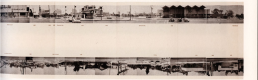
In 1965, Ed Ruscha photographed Every Building on the Sunset Strip, in a way that may sound familiar to those following the Google Streetview release:
Ed Ruscha took the photographs contained in this leporello with a motorized Nikon camera mounted to the back of a pick-up truck. This allowed him to photograph every house on the Sunset
…