Tag Archives: information

Mark Changizi – “Cultural selection as the new blind watchmaker” at “I don’t know where I’m going but I want to be there”

In his presentation at MOTI’s “I don’t know where I’m going but I want to be there” theoretical neurobiologist Mark Changizi elaborated on the research method he applies to investigate the field of why it is that the human brain processes optical information like it does. Instead of…

Book review: Programmed Visions by Wendy Hui Kyong Chun

Wendy Chun’s Programmed Visions book is the third published in a software studies book series initiated by Matthew Fuller. Software studies is a relatively young discipine in digital humanities. Yet, it’s an emerging field, gaining momentum from the overall intrusion of software in our public spaces. As Fuller observes; “few parts of human culture remain untouched by software”, as…

Book review: Enfoldment and Infinity by Laura U. Marks

What are the parallels and relations between Islamic art and New Media art? That is the main question Laura U. Marks poses in her book ‘Enfoldment and Infinity. An Islamic Genealogy of New Media Art’. The title of her book is just as alluring and bold as her topic. During the first two chapters her motivation of the…

Data visualization and story telling

For as long as people have been around, the have used stories to share information, cultural values and experience. Most of the times this is done orally, but even in ancient times, mankind created drawings to visualize their information. With the invention of the printing press, new possibilities arose to share a story, either verbal or with drawings. Until today,…

A Question of Data/Art

A question of data/art*

*delete as necessary

A  well known problem of data visualization is according to Lev Manovich that “people intuitively identify visualizations as infovis even though they consist not from vector elements but from media text or images”. I state that within data art this problem does not persist since data art is fundamentally not about…

Mondrian in the age of Information Visualization.

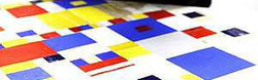
Dutch painter Piet Mondrian (1872-1944) started painting his artworks in the style of the Amsterdam Academy. He made dark realistic landscapes and later in his carer he painted more lighter paintings when he evolved towards De Stijl.  From the year 1911 in Paris he became influenced by the styles of symbolism and cubism. Here he comes…

Commons-based peer produsage? Rethinking online production.

The Internet, and the emergence of Web 2.0 in particular, have been celebrated for their liberatory potential, setting free the individual consumers once bounded by industrial inertia. We only need to take a quick look at the Arctic Monkey’s success through the social networking website MySpace to conclude that potentially, everyone can become famous with hardly any costs or…

Who do you think you are?

Review: Karin Spaink, Wie is U?

Ever had a Déjà vu, the feeling that you have experienced something before? It’s a strange feeling. You can’t exactly explain what it is and where it comes from, but it’s there. You know you’ve been somewhere before or heard something before. Mostly the experience lasts only a moment and then it’s gone.…

Democracy of the Algorithm

Working on the Society of the Query conference, I often find myself confronted with an unquestioned believe in what are believed to be the empowering or even emancipating qualities of universally accessible open and free information. Michael Stevenson once referred to this believe as Information Determinism, as if information by itself will solve social and political issues. Realizing…

‘Useless Content’ – Part 1

‘Wikipedia is not a valid source’. That’s a common critique on the online encyclopedia. Erin Harty from the University of Idaho stresses that the information on Wikipedia doesn’t have any academic background and that it ‘is not really an encyclopedia but an online magazine written by volunteers who do not need to have any specialized knowledge on anything at all’.