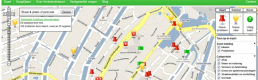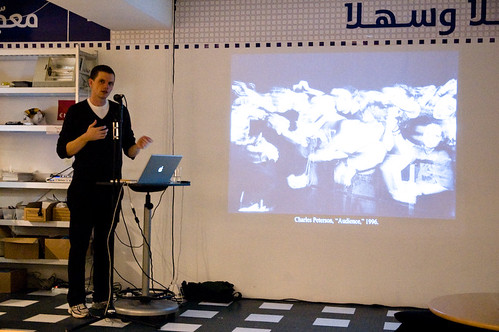
Last Friday the Dutch Central Bureau of Statistics (CBS) held an interactive data visualization day “Datavisualisatie in beweging” initiated by web designer Eugene Tjoa and Bas Broekhuizen.
With this seminar statistic data supplier CBS invited several data visualization professionals, to present their work in order to explore the data visualization field and the different disciplines involved. The main…
http://www.dailymotion.com/videoxghq1z
Tuesday 25th of October I went to see a conference in Brussels of The Netexplorateur Observatory at Institut des Hautes Etudes des Communications Sociales (IHECS). This observatory is formed of sociologists that analyse hundreds of innovation in the area of new media. Every year international experts select the 100 most interesting cases presenting during the annual…
Using public transport, we leave digital traces when checking in and out with our OV chip cards. Once our Bonus Card at Albert Heijn got scanned over the counter, we provide Albert with valuable information about what we like to buy and how often we do so. Even when getting our morning Cappuccino at Starbucks and using a discount coupon on our mobile phone, it’s all about moving data from one spot to another. In other words: we live in data-rich environments and our cities are gradually turning into ‘readable cities’. All that, based on the vast amounts of data which we ourselves perpetually produce.
In his presentation at the Video Vortex #6 conference in Amsterdam, graphic designer and project director Roel Wouters introduced the audience to interactive projects which include dynamic media such as web video and animation to install crowdsourced performances. With his collegues Luna Maurer, Jonathan Puckey and Edo Paulus he has published the Conditional Design Manifesto, which is based on the work of his collective called Conditional Design and emphasizes the idea of following processes in the digital realm rather than its products.
In his talk on the cultural value of amateur video at the Video Vortex #6 conference in Amsterdam, the author, scholar and artist Michael Strangelove explained how amateur productions will gain greater value due to their potential of challenging the meaning of things, their subvertion of capitalist modes of production and their use by individuals as tools for self-representation of the world. Why does ‘Laughing Baby’, ‘David coming back from the dentist’ or the ‘Star Wars Kid’ make a difference in our lives? And what is it that makes online video different from TV? Dr.Strangelove’s answer to this is straight to the point: “It’s the amateur”.
Data theft, child pornography, spying on governments and spreading destructive computer viruses. When thinking of the term ‘hacking’, we usually think of internet crime, computer breakdowns and some geeks sitting in front of their laptop looking for a fresh kill. However, for those who think of themselves as ‘hackers’, hacking means something completely different. It’s about creatively playing with technology, challenging the status quo of things and exploring the world. Did you know that you can hack your own life? I didn’t, but I learned about it yesterday at the conference named “The Future of Hacking” organised by the Club of Amsterdam in collaboration with the Hogeschool van Amsterdam.

Here I am, sitting on a couple of pillows in the front row of Mediamatic’s jam-packed main room. In just a few minutes, the PechaKucha Night Amsterdam Volume 15 will start. 12 presentations given at lightning speed (20 slides of 20 seconds each). Amsterdam is one of the 360 worldwide cities organizing Pecha Kucha nights and it’s…
Shoot a mosque and you will earn 2000 points, shoot a Muslim calling for prayer and you are another 1000 points ahead! What sounds like a mere disaster in terms of religious intolerance can now be seen online with the “Bye Bye Mosque” game, published by the Austrian right-wing Freedom Party (Freiheitliche Partei Österreich) in the Austrian federal state of Styria. Ever since its release last week, this campaign provoked public outrage and debates about the far-right uninhibitedly spreading religious hatred in the country and its never ending campaigning against Islam.
The Accelerated Living was a theme of the 20th edition of the Impakt Festival (Utrecht 2009) that was focused on changing notions of time. It explored the ways in which we experience time and speed, and the ways in which this experience is affected by social and technological developments.
Paul Virilio says that the speed at which something…
On Tuesday October 6th, in the Nederlands Instituut voor Mediakunst in Amsterdam, there was an interesting and envisioning lecture and performance by Amsterdam visual artist Esther Polak (http://realtime.waag.org/). Her main interest in the field of locative media is to trace the actions of the subject in the world, to create new visualizations of these…